
Most people outside manufacturing don’t think much about industrial heating. But for businesses working with metals, ceramics, or electronics, the furnace is one of the most important pieces of equipment on the floor. Without it, production stops.
Continuous furnaces have become a standard part of how modern facilities operate. This post covers what they are, where they’re used, and what business owners should know before making a decision.
What a Continuous Furnace Does?
The simplest way to explain it is this — material goes in one end and comes out the other, without stopping.
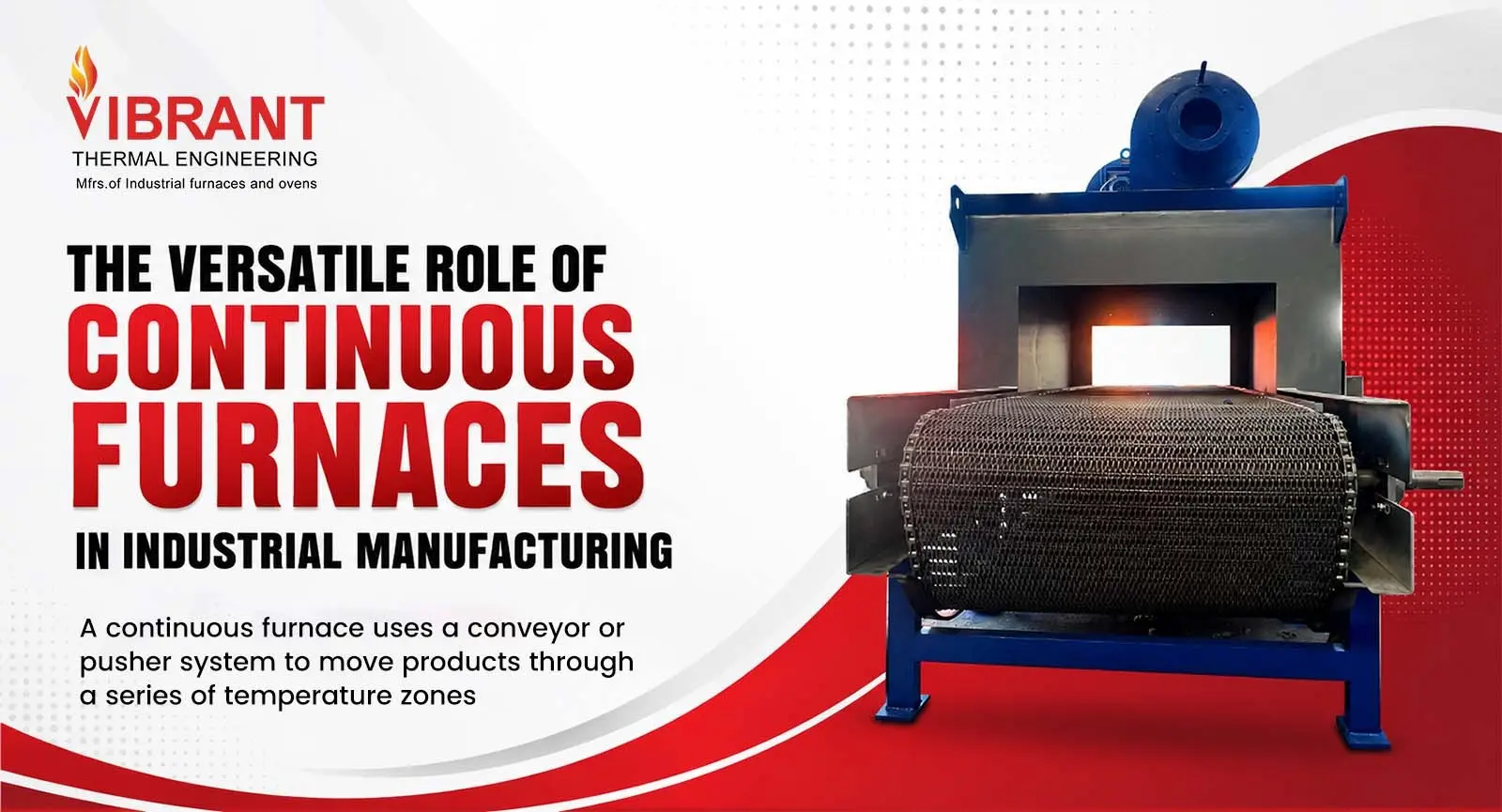
A continuous furnace uses a conveyor or pusher system to move products through a series of temperature zones. Each zone is set to a specific temperature. The material passes through each one in order, gets heated the way it needs to be, and exits as a finished or semi-finished product.
There are no batches. No loading, waiting, unloading, and repeating. It runs as one continuous process — which is exactly where the name comes from.
For businesses that need to process large quantities consistently, this makes a significant difference to what the line can actually produce in a day.
Where Continuous Furnaces Are Used?
Continuous furnaces show up in more industries than most people realise.
Metal processing is the most common. Metals go through different heat treatment processes — annealing, hardening, brazing, sintering — depending on what mechanical properties the finished part needs. Each process has its own temperature and timing requirements, and getting them right is what determines whether the component performs to spec. Continuous furnaces handle this well because each zone in the furnace can be set to a different temperature, so the metal moves through the right conditions at the right time, every time.
Electronics manufacturing relies on continuous furnaces heavily for reflow soldering. Circuit boards move through a controlled heat profile that melts and sets the solder joints. At the volumes electronics factories run, doing this in batches simply isn’t an option.
Ceramics and advanced materials need long exposure to high temperatures to sinter and densify properly. Continuous furnaces can maintain the right atmosphere and temperature across a long chamber in a way that batch systems often can’t match.
Automotive manufacturing uses continuous furnaces as part of the production line itself. Gears, bearings, fasteners, and structural components all go through heat treatment between machining and assembly. Having the furnace integrated into the line means no interruptions.
Metal 3D printing and powder metallurgy are growing applications. Printed metal parts need to go through a sintering process after printing, and continuous furnaces are increasingly the equipment of choice for that step.
Why It Makes Business Sense?
Many business owners come into this decision focused on the technical details — temperatures, conveyor speeds, chamber size. Those things matter, but they’re not the whole picture.
The real question is whether the equipment fits how the business actually runs. Batch and continuous systems have different implications for output, running costs, and how easily the line can adapt when things change.
Output is the most straightforward. A continuous furnace running steadily produces significantly more processed material per shift than a batch system of the same size. If thermal processing is holding up the rest of the line, switching to continuous can remove that bottleneck entirely.
Energy costs are worth looking at carefully. Batch systems heat up and cool down with every cycle. That’s a lot of energy that doesn’t produce anything. Continuous furnaces stay at operating temperature, so the energy used per unit processed is lower. Over a full year of production, the savings adds up.
Labour is the third factor. Continuous systems don’t need someone to manually load and unload between cycles. Once the line is set up and running, the operator involvement is minimal compared to managing a batch operation at the same volume.
That said, continuous furnaces aren’t the right answer for every situation. If volumes are low, if the product mix changes frequently, or if the process requires a long hold time at one temperature, a batch system might still be the better fit. It’s worth having that conversation with a manufacturer before deciding.
Atmosphere Control and Temperature Consistency
Some materials need more than just heat. The environment inside the furnace — the atmosphere — has to be controlled too. Depending on what’s being processed, that might mean an inert atmosphere, a reducing one, or an oxidising one.
Continuous furnaces maintain different atmospheres across different zones and transition between them as the product moves through. That level of control is harder to achieve reliably in batch systems.
Temperature consistency matters equally. The heat needs to be even across the full width of the conveyor, not just at the centre. Good manufacturers put serious work into heating element layout, airflow, and insulation to make sure that’s the case.
Vibrant Thermal Engineering builds each system to the client’s specific requirements — temperature control, atmosphere management, and zone configuration are set up for what’s actually being processed, not pulled from a standard template.
Picking the Right Manufacturer
A continuous furnace is a long-term investment. Most run for years, sometimes decades. The manufacturer matters as much as the machine.
The specification process is where the important decisions get made — chamber dimensions, conveyor speed, thermal profile, atmosphere setup. A furnace that isn’t correctly matched to the application will underperform regardless of how good the components are. That requires a manufacturer who asks the right questions before quoting.
Vibrant Thermal Engineering works through the engineering requirements with each client before recommending a system — a furnace that fits the operation from day one, with support through its full working life.
Get in touch with the team here to talk through your requirements.
Frequently Asked Questions
There’s no fixed number. The clearest sign is usually whether thermal processing is creating a bottleneck — if material is sitting and waiting to be processed before the line can move, that’s the signal. We look at what the operation is currently producing, what it needs to produce, and what the process requirements are before making any recommendation.
It depends on the complexity of the system. A straightforward configuration takes less time than a custom-engineered solution with specific atmosphere requirements or unusual ldimensions. Most projects fall somewhere between 12 and 24 weeks from confirmed order to commissioning. We give a realistic timeline after the engineering review — quoting one before that isn’t particularly honest.
Most continuous furnaces can handle more than one product. How easily depends on how different the thermal profiles are. Similar temperatures and atmospheres — straightforward. Very different requirements — longer changeover times or separate systems may be more practical. Either way, discuss the product mix during specification. It’s easier to plan for it upfront than work around it later.
Heating elements, conveyor parts, and atmosphere systems all have regular service intervals. How much downtime that means depends on the system design and how well the maintenance schedule is followed. Systems that are properly maintained tend to run for years without major issues. We set out a maintenance plan at installation and stay involved through the life of the equipment.
Per unit processed, continuous furnaces use less energy than batch systems at equivalent volumes. Holding a steady temperature is more efficient than heating up and cooling down repeatedly. The actual figure depends on operating temperature, throughput, and insulation quality. We work through estimated running costs during the specification process so there are no surprises once the system is live.

Vibrant Thermal Engineering
Vibrant Thermal, established in 2007, is a leading industrial furnaces & ovens manufacturing organization that offers a one-stop solution to every industrial furnaces & ovens need.
